
The number of daily vehicle movements on the A149 has been consistently above 16,000 / day for the last 15 years. Extensive development now under way or planned at Hunstanton and Heacham will ensure that these figures will continue to grow. Road planners generally consider daily vehicle numbers of 18,000 as a threshold where dual carriageways become necessary. We are therefore very close to the point where dualling the A149 will become a necessary reality.
But, as local residents know only too well — the 20,000+ additional visitors that Hunstanton and North Norfolk can attract on summer days regularly leads to long periods of congestion. And this is not new — it dates back to the 1970s. Successive road ‘improvements’ have not resolved the issue. Arguably, they have made things worse.
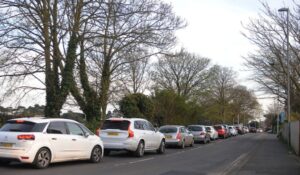
A typical 30-minute car journey from King’s Lynn to Hunstanton on a good day can turn into a 2-hour crawl on the worst days. But these are just the local impacts. Where are these visitors coming from? Lincolnshire, Peterborough, Cambridge and Ely — and further afield — Nottinghamshire and Northamptonshire. North Norfolk is a playground for the East Midlands. The traffic impacts of coast-bound traffic therefore affect the A47, A10, A17 and all the communities along these routes, miles from Norfolk.
Reinstatement of a direct rail service to the coast would offer a real alternative to many of these road journeys – and potentially a more attractive and pleasurable day-trip for many visitors. And remember — train excursions to the coast were, for nearly 100 years, the lifeblood of the Hunstanton rail line — at one time so popular that Hunstanton needed four long platforms to accommodate the trains! (See History)
And statistics suggest rail travel is nine times safer than road travel. Every year there are road accident fatalities involving visitors to the coast on our local roads. Apart from the human tragedy, the average cost of a serious traffic accident involving emergency services is now more than £200,000 — and a fatal accident can cost close to £2m!
Reopening the railway could therefore:
Rail is good for the environment
Road transport is now the largest and fastest growing source of CO2 emissions in Europe, accounting for one-fifth of all emissions. A shift to more efficient low-emission engines and electric cars will help to curb this rise. However, it is now generally agreed that wider use of bio-fuels will lead to higher not lower greenhouse emissions. And use of low-emission engines will obviously not reduce road congestion.
Rail is one of the greener modes of transport. The European Commission’s 2011 White Paper established goals for the transport sector to reach by 2050 and it set out clear ambitions to increase the number of rail passenger journeys as well as rail freight movements.
To get to a sustainable low-carbon economy by 2050, Europe needs to cut emissions from transport by at least 60% compared to 1990: that’s a cut of 70% compared to today’s emissions. This presents a very serious challenge, in particular for freight traffic, where decades of shift from rail to road transport would need to be reversed1.
Rail corridors also take much less space than roads. A railway can potentially accommodate motorway traffic capacity in a quarter of the space.
Potential economic and social benefits
There has been much made in recent years about new ‘Garden Towns’. Politicians and developers alike have promoted large urban expansion areas as ‘garden suburbs’ — suggesting that they represent a modern equivalent of the ‘Garden Cities’ first promoted by the famous planner Ebenezer Howard in the late 19th century. Howard’s work led to new towns like Letchworth and Welwyn, which are famous for their leafy boulevards and generous open spaces. But todays developers choose to overlook that Howard’s original vision was to create ‘walkable’ settlements based around railway stations — where residents could quickly and efficiently commute to London and other neighbouring settlements.
Using a railway station and transport interchange to create a civic focus for new settlement planning still makes sense — and has been used extensively in recent urban expansion in other countries across Europe, Asia, and Australasia.
Basing new settlements around private car ownership uses a lot of space. It has been calculated that many city areas provide 8 parking places for every car — perhaps 2 or 3 at home, 1 at the workplace, 1 at the supermarket and so on. One way or another we all pay for that infrastructure, and all this space provided for cars makes it unavailable for other uses — whether it be cycle paths, street trees or additional buildings.
And of course, not everyone drives. Nobody under 17 drives, and in our ageing society many older citizens don’t want to continue driving. Running a car is expensive. Providing a reliable alternative to car ownership, or at least a reliable alternative to many car journeys, would have real benefits for many people.
Reopening the Hunstanton railway would provide opportunities for new or refurbished stations in King’s Lynn, Hunstanton and all the settlements between. It would allow a rethink of our settlement planning over the next century and beyond. It could help people to choose whether they want to run a car — whereas today for most Norfolk residents, car ownership is a necessity.
And with the continued growth of Cambridge, a quick and easy commute from North Norfolk would make work in Cambridge easy and very viable — especially as many jobs are now flexible and allow periods of homeworking. Cambridge already has a bigger economy than Manchester and is predicted to double again in years to come. King’s Lynn and Hunstanton are both within the Cambridge orbit of growth. Hunstanton is therefore now within an area of national economic importance, hence the term ‘Eastern Economic Heartland’.
A reopened railway line to Hunstanton could:
1 Information taken from the ‘Transport and Environment’ website — a not for profit, non-political EU research group. www.transportenvironment.org/about-us


Watch this brilliant film by James Fox (2021) which shows us something of the experience Victorians would have enjoyed as they travelled to Hunstanton by train. A half hour journey through a rural landscape. One has to wonder about aspects of our subsequent ‘progress’.

John Betjeman Goes By Train from King’s Lynn to Hunstanton in 1962

